Short answer+10 to 15grams of carbs per hour, every week or two
Practice your race fueling on long training rides. Start at what feels comfortable today, step up slowly, and use the same products and timing you plan to use on race day.
An example ramp
Carbs per hour on long rides
Start at a comfortable 50 g (or less) per hour, add about 12 g every two weeks, and reach the race range in about three months. Your own starting point and steps may differ.
Why your stomach complains on long rides
Stomach trouble is one of the most common problems in endurance sports. Bloating, cramps, nausea and urgent stops tend to show up in long or hard sessions, and they get more likely as intake per hour goes up.
The 2026 paper “UCI Sports Nutrition Project: Position Statement on Nutrition for Cycling,” written by 54 researchers, names four levers that help:
Four levers for a calmer gut
From UCI Sports Nutrition Project: Position Statement on Nutrition for Cycling (2026)
Before
What you eat before
How much, which macros, and how long before you start.
During
The type of carbs
Above 60 g of carbs per hour, a mix of fructose and glucose absorbs better than either one alone.
During
How you spread them out
Small, regular amounts are easier on the gut than cramming your whole hour's worth of carbs in at once.
Over weeks
Training the gut
Raise intake step by step over many weeks, or even months, so your gut can adapt.
What you eat before
The meal before a session tops up the carbs stored in your muscles and liver. "UCI Sports Nutrition Project: Position Statement on Nutrition for Cycling" puts pre-session carb targets at 1 to 4 grams of carbs per kilogram of body weight, eaten 1 to 4 hours before the start: the low end for shorter or easier sessions, the high end for long races. For a 70 kg (154.3 lbs) rider, that is about 70 to 280 grams of carbs.
If you know you get an upset stomach when you take in too much during exercise, this pre-session meal is a big opportunity to top off glycogen, and it can give you more fuel than forcing in more during your session. In the meal, and even the day or two, before a key session, try cutting back on foods that slow digestion, usually fiber and fat, and lean on easy carbs you already know you tolerate. Keep the timing the same each time so you learn what works.
Glucose, fructose, or both
Above 60 grams per hour, the mix matters. Some foods and products give you glucose on its own; others combine glucose and fructose, which your gut absorbs through two absorption pathways at once.
Two absorption pathways into your body
Glucose and fructose are absorbed through different gates in the gut
GlucoseMaltodextrin, dextrose, and starches like rice and potatoes
Glucose gate (SGLT1)
Starts to fill up above about 60 g of carbs per hour.
FructoseFruit, agave syrup and crystalline fructose
Fructose gate (GLUT5)
A separate gate, so fructose adds to what glucose brings in. On its own, it is slower and harder on the gut.
Glucose and fructose togetherA mix uses both gates at the same time, so you can absorb more carbs per hour than with either one alone. This is why many gels and drink mixes combine both.
Simplified. The names in brackets are the transport proteins scientists use for each gate.
Which sources are glucose, fructose, or both
Check the ingredients list on any drink, gel or chew
Glucose or fructose only: one absorption pathway
Glucose or fructose on their own have an upper limit you can absorb per hour
Examples of glucose-only items are: maltodextrin-only drink mixes, dextrose tablets, rice cakes, white bread, white rice and potatoes. Examples of mostly fructose items are: agave syrup and crystalline fructose.
Glucose and fructose together: two pathways for absorption
With glucose and fructose mixed, you can absorb more carbs per hour
Examples of glucose plus fructose items are: table sugar, honey, maple syrup, orange juice, fruit and dried fruit, and gels or drink mixes labeled dual-source or with a 2:1 or 1:0.8 ratio.
Your gut adapts
The gut responds to practice. Taking in more carbs during training, step by step over weeks, improves how much your stomach can absorb in a session and how well you tolerate carbs during exercise. This is the strategy behind gut training: increase your carb intake over months so you can take in more on race day.
What practice changes
How many grams per hour feel comfortable, before and after months of gut training
Untrained gutcomfortable to about 50 g per hour
Comfortable
Bloating, cramps, nausea more likely
Months of gradual practice on long rides
Trained gutcomfortable to about 90 g per hour
Comfortable, and more fuel for working muscles
0306090120 g per hour
Illustrative. Where your own comfortable line sits depends on you, your sport and your products.
Without practice, the opposite happens. If you ride fasted or on water most of the time and then try 90 grams per hour on race day, you probably won't tolerate that much and may have serious gut distress. With a little training, you can digest it without a problem and have more fuel for your working muscles.
A simple plan
Six steps to race-day fueling
1
Find your starting point
Note the grams per hour that feel fine on your next long ride.
2
Add a little at a time
+10 to 15 g per hour every week or two.
3
Hold or reduce if your gut pushes back
Bloating or cramping means stay put, or even cut a few carbs, for another week or two.
4
Use race products
Above 60 g per hour, pick a glucose and fructose mix.
5
Practice the same timing
Small amounts every 15 to 20 minutes.
6
Rehearse your morning routine
Eat your planned pre-race meal before key sessions.
If 50 grams per hour is comfortable now, try bumping to 60 or 65 on your next block of long rides. Bloating or cramping means hold at the current carb intake for another week or two before stepping up again.
Nothing new on race day
The best fueling plan is the one you have already done. Race day is not the time to try a new gel, a new drink mix or a bigger number than you have practiced. Long training rides are the time to test new strategies.
In training, rehearse
The exact drink, gel or chew
The grams per hour you plan to race at
The timing, every 15 to 20 minutes
The pre-race meal, at the same time before the start
On race day
Nothing new.Same product, same amount, same timing, same breakfast. The best fueling plan is the one you have already done.
How Augur handles this
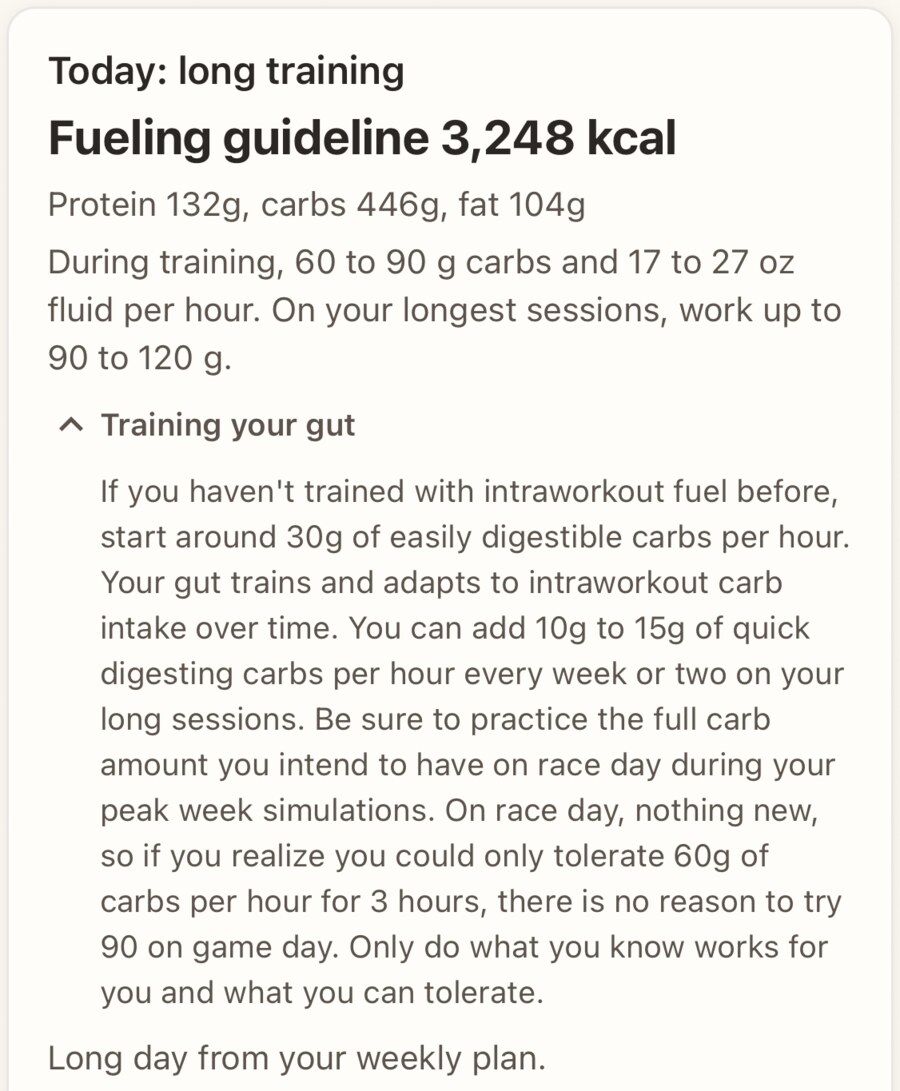
On long days, Augur suggests working up towards 90 to 120 grams of carbs per hour of exercise, so your longest sessions double as gut training. Every training day's card has a "Training your gut" note that tells you how to build towards that target: add 10 to 15 grams per hour every week or two.
In Augur, on every training day
60 to 90 gcarbs per hour on long days
90 to 120 ga goal to reach towards for your long sessions, and working towards that goal lets those sessions double as gut training
Burke et al. (2026). UCI Sports Nutrition Project: Position Statement on Nutrition for Cycling. International Journal of Sport Nutrition and Exercise Metabolism. doi:10.1123/ijsnem.2026-0135
Know your fueling before the session starts.
Plan your training days and Augur sets carbs and fluid per hour for each one.
$199.99 per year after a 14-day free trial. iPhone.