No. 1 · Fueling
The carb ranges above come from the 2026 paper “UCI Sports Nutrition Project: Position Statement on Nutrition for Cycling,” written by 54 researchers. This post shows how to use those carb ranges on your rides.
Your body stores a limited amount of carbohydrate in your muscles and liver. On a long or hard ride, you burn through those stored carbs. Carbs you eat during the ride give your muscles another source of fuel, so you can hold your pace throughout the entire ride instead of fading.
On a long or hard ride, the carbs stored in your muscles and liver go down as the ride goes on.
Carbs you take in on the bike give your muscles another source of fuel.
With that added fuel, you can hold your pace throughout the entire ride instead of fading.
On an easy one-hour ride, the carbs stored in your muscles and liver are usually enough. On a three-hour ride with climbing, those stored carbs are probably not enough.
From UCI Sports Nutrition Project: Position Statement on Nutrition for Cycling (2026)
Smaller athletes may need less fuel overall, larger athletes may need more, and effort matters as much as time.
Smaller riders may need fewer carbs per hour than these ranges, and larger riders may need more. Effort matters as much as time: a two-hour tempo ride needs more carbs per hour than a two-hour easy ride.
Glucose or fructose on their own have an upper limit you can absorb per hour. Glucose and fructose use different absorption pathways, so a mix of the two lets you absorb more carbs per hour than either one alone.
Glucose and fructose are absorbed through different gates in the gut
Simplified. The names in brackets are the transport proteins scientists use for each gate.
Check the ingredients list on any drink, gel or chew
Examples of glucose-only items are: maltodextrin-only drink mixes, dextrose tablets, rice cakes, white bread, white rice and potatoes. Examples of mostly fructose items are: agave syrup and crystalline fructose.
Examples of glucose plus fructose items are: table sugar, honey, maple syrup, orange juice, fruit and dried fruit, and gels or drink mixes labeled dual-source or with a 2:1 or 1:0.8 ratio.
Fructose on its own, like agave syrup, is absorbed slowly and is hard on the gut in large amounts, so use fructose as part of a glucose and fructose mix, not as your only carb source.
If you are aiming above 60 grams of carbs per hour, use drink mixes, gels or chews that combine glucose and fructose. Their labels list both glucose (or maltodextrin) and fructose. Check the label for grams of carbs per serving, because products vary a lot.
The general aim is to finish a ride having lost less than 2% of your body weight to dehydration. You do not need a lab to find your own sweat rate.
Right before a ride, with minimal clothing.
Ride as usual and note how much you drink.
Right after, before eating or drinking anything else.
Subtract your weight after from your weight before, add the weight of what you drank, and subtract anything you urinated. Aim to lose under 2% of your body weight.
For example, if you start at 170.6 lbs and finish at 167.2 lbs without drinking or urinating, you lost 3.4 lbs, or 2% of your body weight, mostly through sweat. That ride was right at the 2% limit.
Repeat this on a few rides in different weather and you will know roughly how much you sweat per hour. Aim to drink enough to stay under that 2% loss, without drinking so much that you finish heavier than you started.
The carb intake you can tolerate is trainable. If 90 grams per hour sounds like a lot, build up to 90 grams per hour step by step on long training rides. We wrote a separate post on how to train your gut for race fueling.
Start at a comfortable 50 g (or less) per hour, add about 12 g every two weeks, and reach the race range in about three months. Your own starting point and steps may differ.
Every planned training day in Augur shows a carbs-per-hour and fluid-per-hour target, set by that day's type of training: light, hard, long or race.
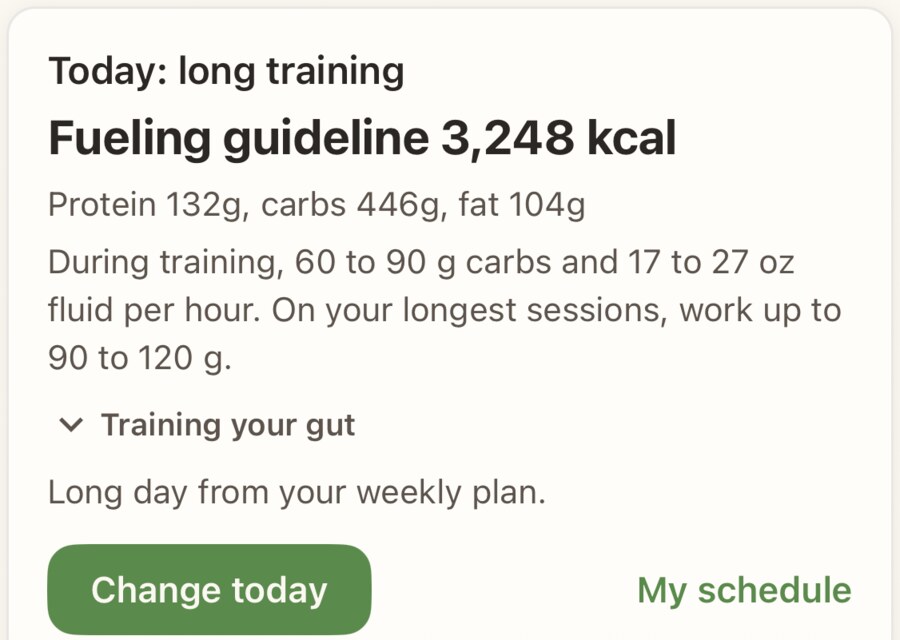
The full targets, with fluid:
| Day | Carbs per hour | Fluid per hour |
|---|---|---|
| Light | 30 to 60 g after the first hour (under 60 minutes, water may be enough) | 400 to 600 mL (14 to 20 oz) |
| Hard | 60 to 90 g | 500 to 750 mL (17 to 25 oz) |
| Long | 60 to 90 g | 500 to 800 mL (17 to 27 oz) |
| Race | 90 to 120 g | 600 to 800 mL (20 to 27 oz) |
Set your weekly training schedule in Augur, and each ride's carb and fluid targets show up before you clip in.

Burke et al. (2026). UCI Sports Nutrition Project: Position Statement on Nutrition for Cycling. International Journal of Sport Nutrition and Exercise Metabolism. doi:10.1123/ijsnem.2026-0135
Plan your training days and Augur sets carbs and fluid per hour for each one.
$199.99 per year after a 14-day free trial. iPhone.